
Have you ever had an idea, noticed a trend, or kept having a fleeting thought about “somebody should do something about [x]”–even when it’s not in your field of expertise or knowledge? Most of us have these moments, and we fight them off, telling ourselves that “people like us don’t do things like that” or “who am I to do [X]?”
But what if you had an idea and decided to bring it to life, even if you’ve never done anything related before or if it doesn’t “make sense” for who you are or what you’ve done in the past? What might evolve and change for you —or others around you—then?
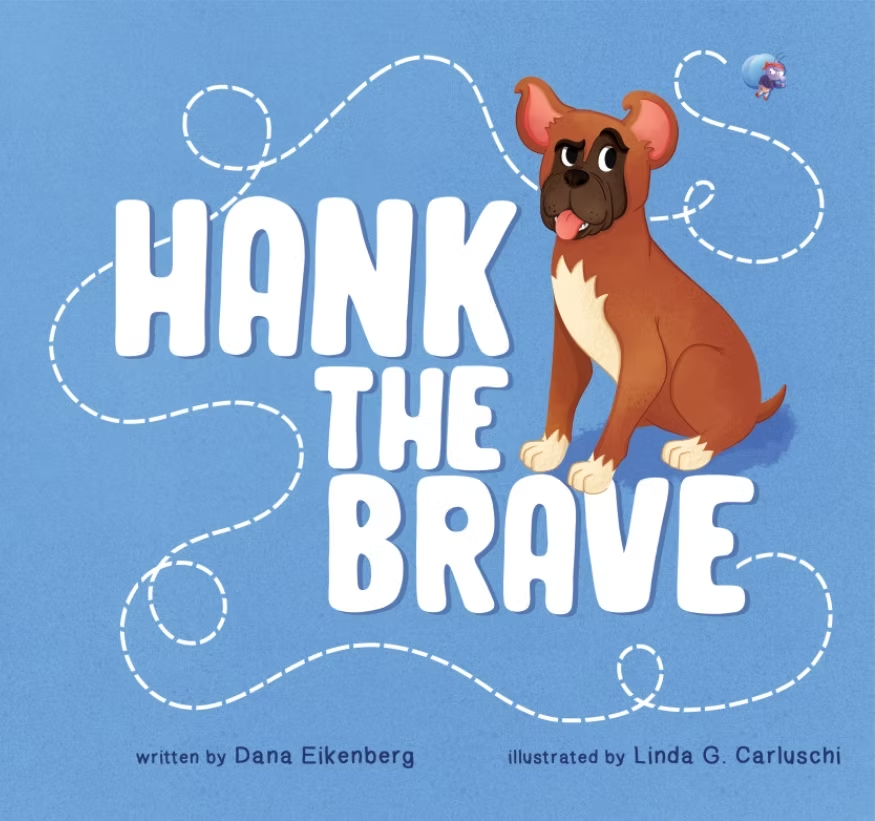
That’s why I decided to interview Dana Eikenberg, the author of the illustrated children’s book Hank the Brave. It’s a funny, heartfelt book about fear, love, and finding the courage to be brave. Dana is former Division I basketball coach turned local entrepreneur, and also has the dubious distinction of being my little sister. ❤️
If you’ve EVER talked yourself out of a new project, job, adventure or anything in life, Dana’s story will help give you the confidence to invest in yourself and try.
Listen to the audio only here:
Get your copy of Hank the Brave here.
Read more about the story of Hank the Brave here.
Transcript (unedited, so apologies for grammar and punctuation errors)
Darcy Eikenberg | Red Cape Revolution
Hello, Red Cape Revolution. I am honored today, thrilled, delighted to be here with one of my favorite people, and it is my sister Dana, who some of you, if you followed my email or my blog for a while, you may have seen pictures, heard stories, whatever. But Dana’s done something that I think is an interesting lesson for a lot of us who come to a point where we think about doing something and we talk ourselves out of it. We lose the battle of the brain.
So Dana has written a new children’s book called Hank the Brave, and it’s on Amazon on her website hankthebrave.com. And I asked her here not to necessarily talk about children’s books, but to really talk about taking an idea or trusting yourself with an idea to move it forward. So Dana, hello, welcome to Red Cape Revolution.
Dana Eikenberg, Hank the Brave
Good afternoon, Darcy, and all your Revolution supporters and followers.
Darcy
So Dana, tell me the story about how Hank the Brave came about.
Dana
So, really, Hank the Brave was written about our 50-pound boxer Hank. And one afternoon, about a year and a half ago, we were sitting out back, and we just noticed all of a sudden a change in his demeanor and a couple clear-cut incidents in the home that we just thought were different, kind of out of character, and we didn’t really think anything of it at first. But then a couple days later, we saw the similar kind of action, and we decided that we better write that down. It just was funny to us, but we could tell in regards to Hank’s actions, he was terrified.
So as you kind of do when you feel someone close to you and you love is terrified, you your love and your support kicks in. So we did what we felt we could do to support him and love him through it until we really understood the problem and what he was fearful of. Well, so as we just kind of started to kick the story around to friends and family, everybody said, “Did you write it down? Did you get? Did you?” No, I hadn’t even thought about it. What was this? What was he scared of? So we obviously live in Florida. We have a kind of inside outside lanai, and we had a fly in the lanai. And at first, we didn’t know what we were scared of. We assumed it was a gecko, or even worse, we thought it was a small black garden snake somewhere in the house. So we, kind of started tearing the house up. But what we came to realize it was a fly. Couldn’t see it, but we certainly once we identified the fear, we could hear it.
So now that we knew what the fear was, we were able and to accomplish the second part is trying to help him through it because he would start to shake, he would hide, he would dive into the into the pillows, and he just he became just completely terrified and paralyzed from it. So we wrote it down.
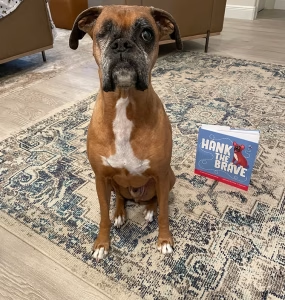
I wrote it. I just kind of got my computer out and just started writing the story from start to finish. I, someone, we laughed at it, but then it really just got me thinking: Is this a story? And is there not that I wanted to teach a lesson, but is there a story to develop here, and something that we all could relate to and fear, and how love certainly helps us with things that make us scared.
Darcy
Now, for some people, their life and their work is around telling stories and being observers of the world and writing stuff down. So, but that hadn’t always been you. Tell me a little bit about your background and what you do for a living.
Dana
So that’s kind of the irony of the whole thing. I was one of those kids that didn’t really want to pick up a book because I was outside playing, and I never felt like picking up a book. locked me, imprisoned me into the house, and I didn’t want to be in the house. And I grew up playing sports.
My background: I played collegiately. I played professionally. I didn’t read a lot, and really had no idea about the literary world in regards of children’s picture books, even all the way up to adults. I wasn’t a big novel reader. I read a lot of business books, but I didn’t read a lot of nonfiction, fiction novels.
So the irony falls that I just kind of really started researching and what storytelling looked like. I used a lot of storytelling in building our business. I felt like that was a way for us to identify who we were, what we did, so the storytelling and the pictures of the authenticity, of authentic ,whatever!
Darcy
. . . authenticity.
Dana
Yes, authenticity of who we are, what we did would help our customers understand that. So I really carried that over into the book that this was a story that happened in our house, and this was true. This is what our house looks like. If you look at the book, you can see things that our house looked like. Our illustrator captured it magnificently, and then I just became engrossed in learning process of how do I take this idea and what do I do with it.
Darcy
So I want to stop there for a second because so you saw something that at first was funny and then it was like, gee this 50 pound box this tough dog right like seemingly tough is afraid of a teeny tiny fly that we can’t even see and so you wrote it down because there was something intriguing and interesting, but tell me more about what you said to yourself that like got you to, hey, is this a book? Is this something I want to share? And then got you to like doing the work because so many times we see people who have an idea that kind of lights them up inside, but all of the shoulds come in, right? So tell me, tell me what was going on for you and how you got past that, or whether you are past it.
Dana
It’s probably an ongoing battle, the getting past the shoulds, but really for me the more I thought about the story, I thought there was more of a bigger connection of that we all have something in our life that we fear, and for me I remember a time when I got fired from a job, and my family was close. They were always available by phone, but nobody was close. I wondered how different I would have reacted and handled that being fired if everybody was around me, and so that’s kind of the deeper thing, the deeper meaning behind Hank the Brave because we were there to handle his fear. We weren’t there to create his fearlessness. We let him still be fear, but we were there to help him through that.
So that just got me thinking. And then at that point, the competitive juices kick in. You read about traditional publishing, you try to decipher what hybrid publishing is, and then obviously you end up with self-publishing. And for me, I had no idea about any of the three tiers, but I did take your advice and decide that I could invest in myself. That it wasn’t necessarily investing in the book, but it was investing in an opportunity to experience something new. And for me, that was understanding how the self-publishing works, what that entails, seeking a professional editor, seeking a professional illustrator, vetting all those people, understanding the process of what’s selling on shelf, the whole marketing part of it, the whole distribution part of it.
It happened at the right time for me. I had some downtime, and I like to continue to learn. And so I put that forward, and as much as I can, one hole led me to the next level of information. Next led me to the next, and now I feel confident that what I’m doing. I’m going about the right way. It may not be profitable, but that wasn’t my end game.
Darcy
Some of the folks watching this who are followers of my work might think, “Oh well, yeah.” Though Darcy has a book. Darcy’s been published or whatever. But just to be clear, like the world of the prescriptive nonfiction world that I’m in is a totally different world than children’s books and illustrated books, especially for littles. four to eight, 910. That your book is targeted to. So, I was not a lot of help during this.
How did you find the resources, and then not talk yourself out? Of oh man, there’s a million people who’ve been doing this for years and years and years. Because one thing I really admire about what you did on this journey is that you dove into self education and finding the right support. Tell me how you did that without like coming at some point, just saying, “Oh, geez, I’ll never get it. I’ll never, I’ll never be one of them. I’ll never understand it.”
Dana
Well, I think from the beginning, I understand there was a difference. There seems to be two different lanes. There’s the traditional publishers, and then there’s the indie authors. Who, I think, sometimes people think that the indie authors are just people that sit down, write a book, shoot it into Amazon, and boom, there it’s published. And we can they can use AI to create it, and that’s a whole different conversation in itself. But the indie authors, what I would fall into, we spend equally as much time, trying to prepare a book, do the do the work behind the book to build a book that is something that somewhere some reader may appreciate. So I probably was ignorant at first.
I reached out to people on Instagram who were larger than life illustrators, larger than life owners of publishing houses, and I had no idea what I was asking, but through kind of understanding what the process was, I just started asking questions. I got probably the kindest reply from one of the best illustrators in the game, just saying, Dana, I appreciate your interest and encouragement. Here’s a couple of people to follow, and. So, my naivete of knowing who I was reaching out to led me to kind of other links to continue to progress through. And the more I found, the more than I was able to write a descriptive of what I was looking for, what I needed, and how to create the lane that I wanted this book to fall into.
Darcy
And I love the fact that you didn’t hold back from reaching out to somebody on social media, or finding their website and just emailing them because I think we forget a lot of times that people who are on other paths that we might appreciate they’re people too. I always ask everybody in my emails, “Hey, hit reply.” It’s amazing how many people don’t or they do like say later, and they’re like, “Oh, I’ve been reading you for years, but I never thought I could ask this question.” It’s like we’re real, right? It’s we’re real people, and you found there were a lot of real people who wanted to help somebody that they didn’t view it as, “Oh, there’s more competition,” or “What does this person know?” But you also educated yourself.
So tell me about the investments that you made and how you decided that was going to be okay for you. Because obviously, we’re in a time costs keep going up. You run a more seasonal business, so you’re busy part of the time. Your other part of the time, you’re a little less busy. We all watch our dollars, and we want something to pay off. Tell me about how you rationalized that for yourself, and really looked at that to not talk yourself out of a path you were on.
Dana
So with that, I had to understand all three tiers of traditional, hybrid, and self, and really, the deep dives kind of gave you a breakdown of how that looked. Sometimes with traditional, there’s a royalty up front, hybrid you pay, but then you lose a little bit of your own control over your own materials, and then with self-publishing, you’re paying first, and but you have complete control. So once I identified, and for me, if I can compartmentalize it in the levels that I needed, whether that be editing, because I knew someone needed to edit my words. I knew there was kind of a word count that we were looking for children’s picture book, and I was well above that. Then obviously had to make the decision with how you wanted to illustrate it. Did you want to illustrate that with someone that you worked with primarily and privately one on one, or were you going to open that up to a group of people?
So those major things, and then at once the distribution publishing, and then after the whole book writing bit becomes how you even before you finish your book is how are you going to market it, and what are your expenses going to look like marketing? I knew from my standpoint, would probably be more local marketing as opposed to global world. So for me, it was just identifying a strong group of our library systems, our school systems, and now we’re running into the holiday season, so holiday bazaars and craft fairs, and how we can just become a vendor to sell some of those books. It all kind of led me to a figure, and that figure is where I kind of set it on, and we were just a little bit short of a dent, of that before we started selling books. So we have made recouped some of that as we’ve sold, but I set a figure, and that’s that’s an intimidating figure because you’re you’re willing to spend that, but as I begin to understand ingest, that was a that was an investment in me.
Darcy
Yeah, and I think that’s an important point: is that a lot of times there’s something we want to do. there’s a change we want to make. There’s a something we want to learn that we’re just not learning by watching a YouTube video or asking Claude or ChatGPT, but that it does take committing an investment of money and time and energy, to something. So, what do you see for yourself as the payoff of that investment because I think you said yourself it’s probably not profitable. books don’t only a handful of books in the world that actually make a profit based on all the time and effort that goes into it. What’s the profit for you of working on Hank the Brave.
Dana
Well, I think there’s probably an emotional part of it, and something you feel like. I know everybody kind of has a part in their life. You feel you want to give. There’s something to give, and Hank’s story is one that I feel like we can give whether that’s one family, one adult, somebody may connect with that. So for me, it’s throwing our experiences out there and may connect with one family, one young person that’s fearful of something, and help their mom and dad how to help them, through it.
The other part, I think, is, what the payoff for us has been spending time with people in front in story times at libraries, going to hospitals, having groups, having conversations, receiving the pictures of someone with a book, so it’s there’s nothing financial in that, but it’s all very rewarding. That to and it makes, our goal was if one story could reach one pair of hands that it helped, then we succeeded, and we feel very strongly about that. That’s occurred.
So, it’s going to take us to Denver in February to speak at a literacy conference, and we’re going to talk about the language of brave. So we’ve taken the book and kind of expanded it a little bit to where we can help sport coaches or teachers or even advisors just discuss maybe just a slight change in how you speak to somebody that has fear.
Darcy
Yeah, I think it’s so important today because there’s a lot of fear. To your point of like the little fly analogy, buzzing around us, right? And it’s really easy to just want to go hide, but I think some of the things that we’re hearing from your book are, people knowing that having friends, loved ones, family, having love in your life can help not push it away. The flies are always going to be there, but to really help you find your way through it and not just suck it up and get over it. So I’m curious, what’s been the most surprising thing for you now, looking back at this first book, and you’re starting a second book, right?
Dana
We were, we before we had even gotten the first book out of the illustrator’s hands, we had another situation that occurred with Hank, and this I could see his story in it right away, and so we again just kind of did the same process began, but it took us a while, as we lost Tank before the second book was completed, so that took us a that kind of froze us in our tracks for a while. But then I felt like we needed to honor that, continue that story because that story has a lot about identity and change that I think will connect with. A different audience, but probably the greatest thing we’ve gotten is just the number of people who have reached out and really applauded and enjoyed it, laughed at it.
We love the fact that our favorite line is when somebody tells us that they want to read it again, or we’ve been reading it. Someone says we’ve read it for four nights in a row. For us, I can hear that the anguish and the pain in the parents, but I that for us makes us feel really good. So there’s just lots to share. Hank was a great dog, and I just feel that if we can, share that and share our immense love, that’s gonna hopefully help more people. Yeah.
So, what advice would you have for people who have an idea? Maybe it’s not a book, but maybe it’s something in their community or something at their job or some other type of business, like something where there’s a spark of an idea. what would you advise them to kind of be able to fan that flame and keep moving forward. I can’t say that I was one that probably jumped on ideas, probably before this I was very calculated with my thoughts. I didn’t want to fail, but then I just think with this it was like I knew I couldn’t fail because first of all it was my story and my story is solely my story. It’s not anybody else’s. Nobody’s going to write the same book. Somebody may have a dog book with a same point of view from a dog, but it’s my story. And I think I just made that decision that why not?
We read so many of the stories that if we don’t try, it’s never going to happen, and I was one of those. Why should I not put efforts forward? If I’m not going to put efforts, then who’s going to put the effort for me out there? And what I found is, once I was able to identify a great team of an editor and an illustrator, and reviewers and people would help support that. that only made me better.
And the product of what we sell, just a much better product, and find different lanes for it. So you don’t have anything to lose, I could quietly go away, and nobody’s going to even know I wrote a book unless you see it on Google. But I knew that I wanted to follow through with this. Our goal has been three books and a picture book series. I think we’re still on track for that, and that then caps kind of our goal of this whole idea.
Darcy
Yeah, it’s great. Really important question. What’s the most amazing thing that you’ve learned from your sister?
Dana
Well, since we’re taping this, and I know this come back at me, really, you’re the one that convinced me that the investment, because I’m tight, and really, I don’t spend our business money easy. I don’t spend my personal money easy, and making a decision to spend money on something that I had no idea in the beginning how what that money was going to was really the investment in myself and it’s been a lesson it’s been an education.
I’ve actually been able to speak two or three times to publications and professionals on the whole self-publishing world and how that works, and so hopefully maybe I’ve helped someone like myself say, “Okay, this is okay. I’m this. I’m following this step.” Because there’s a lot of professionals out there. There’s a lot of gurus, and I’ve watched everybody’s video who claims to be an expert on self publishing.
So, but you said invest. Look at it as investment in yourself, and with that, you can’t go wrong. And I listened,
Darcy
And you listened. I, in all honesty, that was yeah, it was a setup question, obviously. But I we’ve all struggled with that. I’ve struggled with that myself. Even knowing that a lot of my business is based on people choosing to invest in themselves, right? Because there’s not an easy answer to the I have something burning inside me, or I have a maybe not even burning, but it’s the what I call listening to the whispers. It’s like I’ve got to whisper something. Is there something there? How do I feed it? And sometimes it takes money, time, energy, all three.
And I, and I just to say it, I’m really proud of you for following that. For of all the things that I’ve said to you, actually listening once in a while to something. But in the end, you have the chance to help other people too by starting conversation about, what fear really looks what bravery can look like, that it doesn’t have to be the Bravanti bravery. So Hank the Brave. Tell people where they can get their own copy and how they could reach you.
Dana
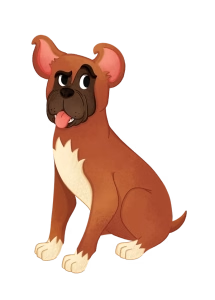
So you can get a hard copy and paperback copy on Amazon.com. Obviously, easy. Go right there. Select which edition you’d love. The hard copy is beautifully done. I would be wrong to admit our illustrator Linda Carlucci, who is actually an Italian native living in London, did a beautiful job. All her illustrations are through the pictures we sent. She never met Hank, and she really captured the essence of him and his sidekick Claud to an amazing degree.
So, also check out our website hankthebrave.com. You can order, and there’s links there that take you right to the book. Also gives you an update of where we’re going to be in the community and where we’re going to be speaking. Some of our past conversations with people on Zoom as well, and certainly a little bit more insight behind the book, and a little bit more about myself.
Darcy
Yes, and if you have a parent group, a library group, a reading group, or something, and you want Dana to connect with you all, I know that she’s been happy to connect and is doing a great job of connecting. And Dana, I appreciate you connecting with my audience today here at Red Cape Revolution. Thank you for not only being a good partner in a lot of things that we do, but also a good sister.
Dana
You are very welcome. Thanks for being a good big sister. Bye.
Darcy
Bye for now!